

Ilya Repin's Beautiful Dilemma
Sadko in the Underwater Kingdom (1876)

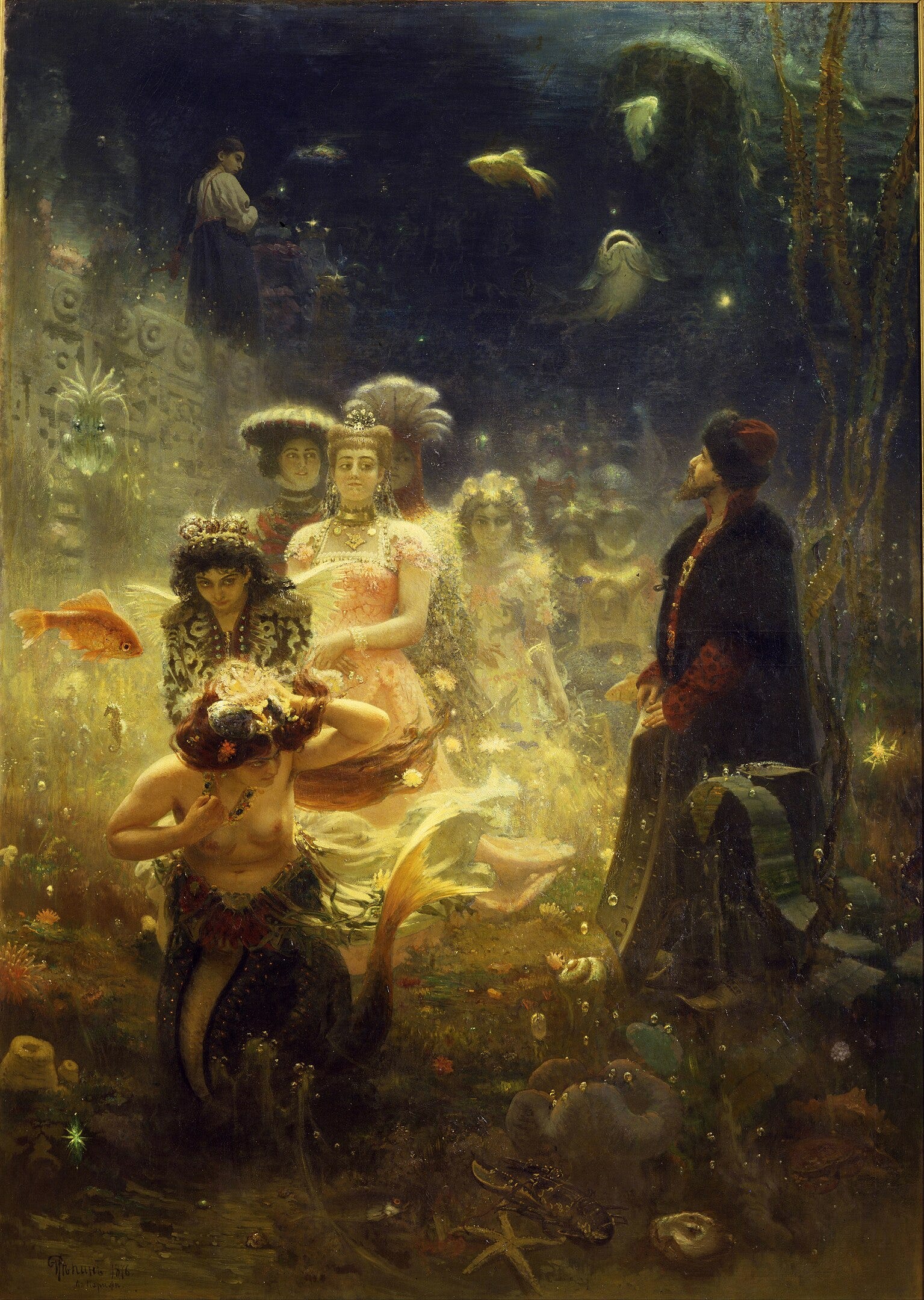
Ilya Repin's painting Sadko in the Underwater Kingdom, also known as simply Sadko, was painted in 1876.
This is a monumental oil-on-canvas work and measures 3.2 by 2.3 metres (10'6" by 7'7"). The painting draws from the Russian bylina - an epic oral poem - about Sadko, a merchant-musician from Novgorod who plays a gusli (an East Slavic multi-string instrument) for the Sea Tsar underwater.
After causing a storm with his music, Sadko, placed at the bottom right of the canvas, must now select a bride from among the Tsar’s three hundred mermaid daughters. He refuses the three hundred daughters three times each, but following the advice of a saint, he accepts the last one in line, named Chernavushka, who stands on the top left looking down at Sadko.
The painting is done from a low angle, looking up at the scene, with the horizon pushed high to emphasize height and scale. This helps to emphasize the procession of fantastical, half-human, half-aquatic subjects.
Our titular subject, Sadko, has his gaze fixed on the modest Russian bride Chernavushka, behind the disappointed and ornately dressed mermaids who came before her. The choice in their clothing is symbolic and is meant to reflect a loyalty to Russian cultural roots amidst an array of alluring, diverse alternatives.
Repin’s work is as much a product of his personal experience as it is of folklore.
Painted while he was an expatriate in Paris, the artist infused the piece with his feelings of artistic and cultural exile. In letters, Repin described the painting as a reflection of his own state of mind and of Russian art at the time, caught between the allure of cosmopolitan influences and the pull of native tradition.
To build the rich visual vocabulary of this underwater kingdom, Repin studied the maps of Sea World, sketched the sea-life of Normandy, and the Crystal Palace in London.
Beyond its folklore narrative, this painting can be read as a metaphorical statement on artistic integrity and choosing to embrace one’s origins despite the temptations of more socially acceptable prospects.
When this piece was debuted, it polarized Russian audiences. Conservative Slavophile critics praised its nationalistic symbolism and technical mastery, while the liberal newspaper Golos referred to it as a "tragic mistake." Despite mixed reviews, however, the painting earned Repin membership in the Imperial Academy of Arts and was acquired by the future Tsar Alexander III, who kept it in the Alexander Palace before moving it to the Russian Museum in Saint Petersburg, where it resides today.
With Love,
Behind the Masterpiece